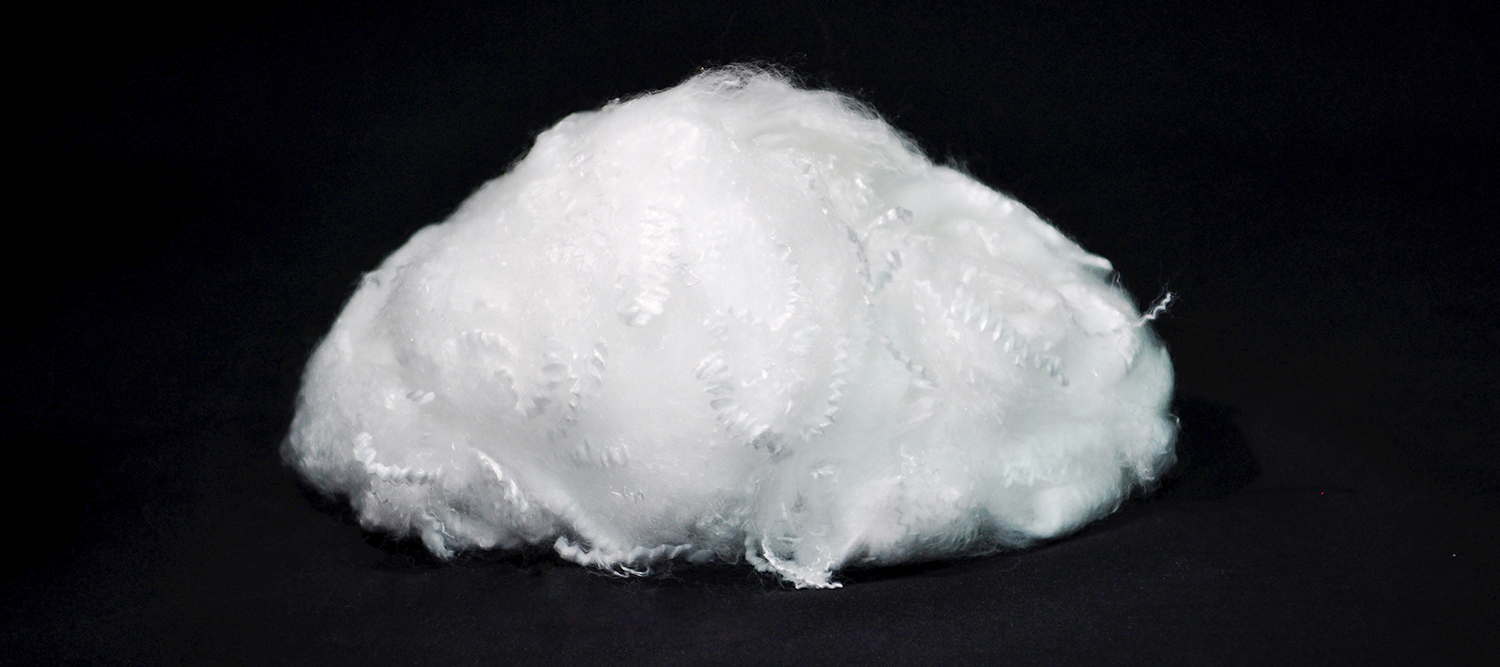
Low melt fiber is a type of bicomponent synthetic fiber engineered to bond with surrounding fibers when exposed to heat — without the need for adhesives or chemical binders. It is most commonly produced in a sheath-core structure: the outer sheath is made from a low-melting-point polymer (typically between 110°C and 180°C), while the inner core retains a higher-melting polymer that preserves the fiber's structural integrity.
When heat is applied during processing, the sheath melts and fuses with neighboring fibers. Once cooled, a firm, stable bond is formed. The result is a lightweight, cohesive material with strong internal bonding — achieved entirely through thermal activation.
The bonding mechanism behind low melt fiber is straightforward: heat activates the outer sheath, causing it to flow into contact points with adjacent fibers. The core remains solid throughout this process, ensuring the fiber retains its length and load-bearing properties.
During processing, fiber blends containing low melt fiber are fed through an oven or hot calendar roll. As temperatures rise above the sheath's melting point, the sheath softens and migrates to fiber-to-fiber contact zones. Cooling then locks these contact points into a rigid three-dimensional matrix — creating a nonwoven or composite structure with excellent dimensional stability.
This process eliminates the need for liquid adhesives, reduces volatile organic compound (VOC) emissions, and simplifies the production line. Because the bond is formed by the fiber itself, the final product is cleaner, more consistent, and easier to recycle.
Low melt fiber is widely used across industries wherever thermal bonding is required to produce lightweight, durable, and cohesive materials.
Serves as the primary bonding agent in thermally bonded nonwovens, replacing chemical binders in hygiene, medical, and filtration products.
Used in door panels, headliners, and trunk liners where lightweight, formable, and bondable composites are essential.
Blended into pillow fill and mattress wadding to improve loft stability and prevent fiber migration over time.
Provides structural integrity to air and liquid filter layers without chemical treatments that could compromise purity.
Reinforces thermal and acoustic insulation batts, improving cohesion and handling during installation.
For manufacturers looking to optimize both performance and process efficiency, low melt fiber offers several compelling advantages over conventional bonding methods.
Eliminates liquid adhesives, reducing cost and process complexity
Delivers uniform bonding strength throughout the material
Supports recyclability — no foreign chemical residues
Compatible with standard thermal bonding equipment
Maintains dimensional stability under mechanical stress
Enables precise control over product softness and density
Low melt fiber is more than a bonding agent — it is a production enabler. By integrating the adhesive function directly into the fiber structure, it allows manufacturers to simplify their process, reduce chemical dependency, and produce cleaner, more consistent end products. Whether you are working in nonwovens, automotive, filtration, or bedding, low melt fiber offers a reliable and scalable solution for thermal bonding applications.
Looking for a reliable low melt fiber supplier for your production line? Our team is ready to help you find the right specification for your application.
Request a Sample